Polizeieinsatz im Hambi am 06.09.26 / Police operation in Hambi on September 6, 2026
for english see below
Im Zusammenhang mit der durch die Hetze verschiedener Medien begleiteten Jagd nach Daniel V. kam es am Sonntag dem 06.09.26 im und um den Hambacher Wald zu einem Großeinsatz der Polizei.
Gegen Mittag umstellte die Polizei zunächst den Wald und das Wiesencamp (Meadow). Mehr schlecht als recht durchsuchten die rückgratlosen Büttel daraufhin von Ost nach West den Wald.
Im Zuge dessen versuchten die Cops mit Hilfe von Drohnen in Baumhäuser zu schauen, manchmal standen sie auch nur unter Baumhäusern und haben hoch gerufen, um zu schauen, ob wer antwortet.
Bei besetzten Strukturen schien die Polizei überfordert und versuchte die vermummten Menschen in der Höhe zu überreden doch herunterzusteigen und sich zu identifizieren. Dieser Vorschlag wurde abgelehnt, nach einer kurzen Belagerung brachen die Cops den Einsatz ab und zogen von dannen.
Die meisten Bodenstrukturen, wie Zelte, Wohnwagen und Hütten wurden oberflächlich durchsucht.
Sicher wurden auch unbesetzte Stelzenhäuser von den Cops betreten. Festnahmen gab es nach unserer Kenntnis nicht.
Wir erklären uns solidarisch mit Daniel V. – gegen die Kohlemine und ihre Welt
einige Kreaturen aus dem Wald
___________________________________________________________________________
english
In the context of the hunt for Daniel V. and the accompanying media campaign there was a large-scale police operation in and around the Hambacher Forest on Sunday, September 6, 2026.
Around noon police surrounded Forest and Meadow. After that the spineless cops halfheartedly searched the forest going from east to west. While doing so, they tried to look into treehouses using drones. At times the cops were just standing underneath treehouses and shouted up to see if someone would respond. Occupied structures seemed to be more than they could handle, so they resorted to trying to convince the masked up people to come down and identify themselves. This request was rejected and after a short siege police aborted their operation and left.
Most ground structures like tents, caravans and cabins were superficially searched. Also structures which were both unoccupied and accessible by ladder were entered by the cops.
As far as we know there were no arrests.
We declare our solidarity with Daniel V. – against the coalmine and it’s world
some critters from the forest
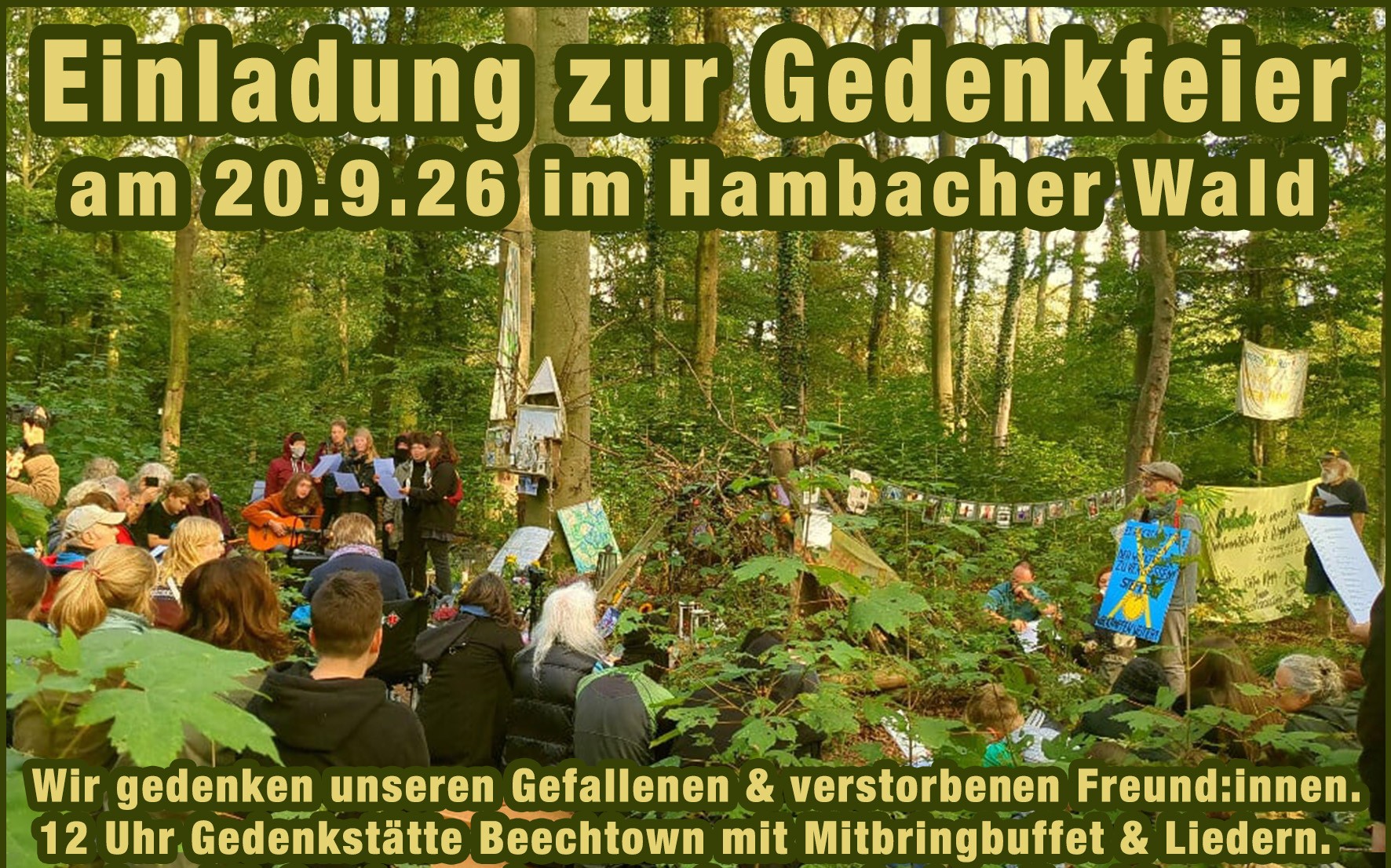
Herzliche Einladung: Gedenkfeier im Hambacher Wald am 20.9.26
In den vergangenen Jahren mussten wir Abschied nehmen von Freund:innen, mit denen wir Seite an Seite im und für den Hambacher Wald gelebt, gekämpft und geträumt haben. Einige von ihnen gaben ihr Leben in der Verteidigung der Revolution in Rojava und Kurdistan. Ihr Lachen, ihre Solidarität und ihre Liebe, ihre Kreativität und ihre Verbundenheit mit dem Wald, dem Leben, dem Chaos, der Musik, den Tieren, der Kunst und dem Widerstand wirken in uns weiter.
Anlässlich des Todestages von „Sonne“ Steffen Meyn laden wir euch herzlich ein, am Sonntag, den 20. September 2026, um 12 Uhr in Beechtown an der Gedenkstätte zusammenzukommen. Wir möchten gemeinsam Raum schaffen für Geschichten, Erinnerungen, Fotos und Lieder – und uns in einem Mitbring-Buffet gegenseitig stärken. Kommt gern mit dem, was ihr im Herzen tragt – und mit dem, was ihr teilen möchtet. Wir freuen uns darauf, gemeinsam zu erinnern, zu erzählen und zuzuhören.
Zu einigen unserer Freund:innen wurden bereits Berichte und Fotos zusammengestellt, unter anderem zu: Sonne / Steffen Meyn, Waka / Şehîd Şahin Qereçox / Farid Medjahed, Elf ,Mike, Mogli, Lobo / Şehîd Elefteria Hambi / Eva Maria Steiger. Mehr dazu findet ihr hier: https://hambacherforst.org/besetzung/gedenkenhambacherforst
🏴☠️ Prozesstermin verschoben!! Kohle-Baggerbesetzung 2025/26 — Trial Date Postponed
Zum Auftakt der Rodungssaison 2025/2026 besetzten einige Piratis einen Kohlebagger und einen Förderbandknoten im Tagebau Hambach. Der Bagger stand mehrere Stunden still, die Zerstörung des Sündenwäldchen wurde um einen Moment verzögert, die irrsinnigen Yachthafenpläne bloßgestellt! 🏴☠️ 🦜 🧚🏼♀️
Der erste Prozesstermin, am 29.7. wurde verschoben!
Also – bitte kommt nicht zum Amtsgericht. Nutzt die Zeit stattdessen, euch mit euren Freundis gegen Kohle und Faschismus zu organisieren!
Wir melden uns bald mit neuen Terminen <3
At the start of the cutting season in 2025/2026 some pirates occupied a coal excavator and a conveyor belt node in the open-pit Hambach mine. The excavator stood still for several hours, the destruction of the Forest of Sins (Sündenwäldchen) was delayed for a moment, the mind-boggling yacht harbour plans were exposed! 🏴☠️ 🦜 🧚🏼♀️
Now the first trial date, on the 29.7. has been postponed!
So – please don’t come to the district court. Use the time instead to organize with your friends against coal and fascism!
We will let you know soon about new dates <3
Tiere im Hambi brauchen Wasser!
Der Hambacher Wald leidet unter der anhaltenden Trockenheit. Ein zentral gelegener Teich, der vielen Wildtieren als wichtige Wasserstelle dient, ist inzwischen ausgetrocknet.
Deshalb bringen Menschen vor Ort Wasser in den Wald, um den Tieren in dieser Situation zu helfen. Jede Unterstützung kann einen Unterschied machen.
Wenn ihr Zeit und Möglichkeiten habt, beteiligt euch gerne und helft mit, Wasser in den Hambacher Wald zu bringen. Gemeinsam können wir den Tieren durch diese Trockenperiode helfen. Der kürzeste Weg zum Teich geht von der Secu-Road (L276) UTM-Koordinaten 328914/5639486 aus (Eingang durch gelb-schwarzes Band gekennzeichnet) und dem Trampelpfad folgend.
Es gibt neben dem Teich noch eine weitere Tränke nahe der Hambi-Oase, die von Menschen bewässert wird.
Teilt den Aufruf gerne weiter.
Hambi bleibt!
Wer kein eigenes Wasser mitbringen kann, hat die Möglichkeit im Hambicamp (in Morschenich-Alt, jetzt umbenannt in „Bürgewald“) Kanister zu leihen und aufzufüllen. Von dort aus sind es ca 3km bis zum Eingang in den Wald nahe der Wasserstelle. Telefonischer Kontakt: Null eins siebensieben, 8707912
Wer bei sich zuhause nicht mehr genutzten Gartenschlauch hat, bringe ihn bitte mit. Eine Idee ist, Gartenschläuche zu verbinden, um die 170m vom Teich zur Secu-Road (L276) zu überbrücken. Dann kann an der Strasse das Wasser eingefüllt werden, was durch den Höhenunterschied bis zur Wasserstelle läuft.
Jedes Leben brauch Wasser!
Da die Trockenperiode vielerorts anhält, ist es auch bei sich zuhause sinnvoll, Tiere durch Aufstellen von Wasserschalen zu unterstützen.
Eine Anleitung findest du z.B. hier
A CALL TO EVERYONE WHO (STILL) WANTS TO FIGHT AND WANTS TO MEET FACE TO FACE!
(deutsche Übersetzung Unten)
Hambi has been occupied for more than 14 years now, shaped and plagued by ups and downs throughout its history. Since then, creatures try to create a place that is open to everyone who respects the forest and its inhabitants—a place where rebellious beings, tormented by society, can find refuge; a place where beings teach each other skills, experiment, and play, A place where resistance is lived out and an anarchist free space that has never since made any compromises with the state or industry.
Quite the opposite of what BUND, most politicians, NRWE, and the initiatives they fund, such as Neuland/tu! Hambach and those who believe their greenwashing fairy tales, the forest is not saved! The groundwater level is still at a low point, the diggers are still digging, the planned lake should be filled by a drying-up river and will then remain toxic for quite some time, the farce of the nature reserve, Nothing will bring the Sündi back, and tech-industrial capitalism continues to exist, and its hunger will keep devouring the Earth. (Others have written more on this; check out the Hambi Blog.)
Today,…
the forest, its inhabitants, and the entire region (in fact, the entire Earth) face yet another threat: the region’s transition from coal to AI. At this place, this is currently reflected above all in the vision of NRWE and the municipalities of Merzenich and Morschenich to restructure and gentrify Morschenich into “Würgebald” the village of the future´, and they attract industries such as the Jülich Research Center or tech startups like the RWE-funded Neuland Hambach GmbH and others to settle in the area.
In fact, this is yet another extractivist(*1) project with disastrous consequences on a global scale—an attempt to reintegrate a largely deserted village, which just a few years ago was slated to be sacrificed to industry’s hunger for energy, back into the state’s administrative apparatus, only to make it available once again to tech-industrial capitalism.
We don’t have to look far back in history to find countless examples that show that politics and industry do not act in the interests of those they claim to represent. They mainly shake hands with each other—all in the name of sacred production, the apparatus of accumulation (*2) that keeps tech-industrial capitalism running.
Many questions remain unanswered… but what we can say with certainty is that politicians and industry are certainly not acting in our interests, and neither the forest nor Morschenich need this state’s paternal care, which for those who want to play and live wild and free can only be a cage.
Many questions remain unanswered… and that’s a good!
It just means we have more leeway to ask our own questions and that we can take action now to prevent worse things from happening.
The forest…
is not just a place, not just an autonomous zone, and it is certainly not a recreational area or simply a piece of nature that is lifeless and with which humans have merely a utilitarian relationship. No! The forest is both life and habitat. It shows that, within a network of beings that interact with one another, we are part of a gigantic earthly being. No being can exist without countless others.
Here in this forest, we can experiment across species to see how we can relate to one another in a way based on reciprocity and solidarity. Beyond the fact that we, as human beings, can meet here and find refuge, prepare for the next revolts, or fight against the aforementioned bullshit, there are always even more reasons to fight and live in this place.
Around the forest, monoculture farming prevents the forest from expanding and, as a result, also limits the shrinking habitat and refuge for many feral creatures, especially non-human ones, which are usually hunted and poisoned on agricultural land. Permaculture and food forests can be helpful alternatives.
It is about to radically break with the separation between humans and nature, to run feral, to allow feral things to grow and to welcome them, and to take the necessary steps to free beings and places from the grip of techno-industrial capitalism.
Let the forest grow! Feralization instead of renaturalization!
„Wherever you are, wilderness is only a few feet away. Under the pavements and roads, under every building, is the subsoil which will one day give birth to the forest which will tear open the tarmac and rend the concrete palaces to dust.“- Living Wild, Wilderness and our place in it
The village…
has not been “saved”; it is being returned to state control, and the plans that the municipality of Merzenich intends to implement in Morschenich do not bode well. In collaboration with RWTH Aachen University, Aachen University of Applied Sciences, BioökonomieREVIER/Jülich Research Center, the Rhineland Regional Council, and With support from the Center of Excellence for Regional Development, the Federal Institute for Research on Building, Urban Affairs, and Spatial Development, NABU, the Nell-Breuning-Haus, the DGB project REVIERWENDE, and the Zukunftsagentur Rheinisches Revier, Morschenich is set to undergo gentrification as a “place of the future” in the spirit of this “green technological transition.”
We don’t believe in the fairy tales about green technology, and we’d rather build a village from the ground up ourselves, together with our neighbors, the refugees, the long-time residents, the trailer park community, and everyone who is (still) willing to fight…
We dream of a large community-based-agriculture, a food distribution center, a freeshop, a café that serves as a community hub, people who get together to do sports, a legal counseling center (specializing in asylum and criminal law), graffiti and street art, a punk bar and stage, a library, community bicycles and a well-equipped workshop, a computer/hack space, open fences and much more. We’re standing in front of an almost empty village with so many possibilities—let’s seize these opportunities and wrest this village from the clutches of tech-industrial capitalism!
Bürgewald must die so that Morschenich can live!
„To give up hope for global anarchist revolution is not to resign oneself to anarchy remaining an eternal protest. Seaweed puts it well: „Revolution is not everywhere or nowhere. Any bioregion can be liberated through a succession of events and strategies based on the conditions unique to it, mostly as the grip of civilisation in that area weakens through its own volition or through the efforts of its inhabitants… Civilisation didn’t succeed everywhere at once, and so it’s undoing might only occur to varying degrees in different places at different times.“ Even if an area is seemingly fully under the control of authority there are always places to go, to live in, to love in and to resist from. And we can extend those spaces. The global situation may seem beyond us, but the local never is. As anarchists we are neither entirely powerless nor potentially omnipotent (thankfully).“ -Desert
Our struggle was never just about coal! From the very beginning, the occupation has targeted tech-industrial capitalism itself as well as patriarchy, and has experimented with anarchist and non-hierarchical ways of life. Let’s keep this up, expand our presence, and intensify the revolt. This isn’t an attempt to launch a campaign or anything like that; it’s
a call to everyone who (still) wants to fight and meet face to face—and especially to those who don’t want to wait for the revolution, who dream of the ruins of civilization, and who are planning their own revolts…
this is an invitation to insurrection towards post-civilized Anarchy!
COME ON OVER!
(*1) Extractivism (from the Latin ex-trahere, “to draw out”; ex-tractum, “that which has been drawn out”) refers to forms of economic activity in unclaimed natural environments in which natural resources (such as mineral deposits, wild plants, or animals) are extracted, utilized, and marketed.
(*2) In an economic sense, accumulation generally refers to the amassing of wealth in the form of money or means of production
-some black sheeps who want to run feral
GERMAN:
EIN AUFRUF AN ALLE DIE (NOCH) KÄMPFEN WOLLEN UND SICH VON ANGESICHT ZU ANGESICHT BEGEGNEN WOLLEN!
Der Hambi ist seit nun mehr als 14 Jahren besetzt, geprägt und geplagt von Auf und Abs im Laufe seiner Geschichte, seither wird versucht einen Ort zu schaffen der offen ist für Alle, die den Wald und dessen Bewohnis respektieren, ein Ort an dem widerständige und von der Gesellschaft geplagte Wesen Zuflucht finden, ein Ort an dem Wesen sich gegenseitig Fähigkeiten beibringen, zum ausprobieren und spielen, ein Ort an dem Widerstand gelebt wird und ein anarchistischer Freiraum welcher seither keine Kompromisse mit dem Staat oder der Industrie eingegangen ist.
Ganz im Gegenteil dazu was der BUND, sämtliche Politiker:innen, NRWE und die von ihnen finanzierten Initiativen wie Neuland/tu! Hambach und jene die ihre Greenwashing-Märchen glauben, sagen, ist der Wald ist nicht gerettet! Das Grundwasser ist immernoch auf tiefstand, die Bagger baggern, der geplante See soll durch einen austrocknenden Fluss befüllt werden und dann wird er eine ganze Weile giftig sein, die Farce von dem Naturschutzgebiet, den Sündi holt auch nichts mehr zurück und der techno-industrielle Kapitalismus existiert weiter und sein Hunger wird weiter die Erde fressen. (Andere haben dazu mehr geschrieben, checkt dazu den Hambi-Blog)
Heute,…
steht der Wald, dessen Bewohnis und die ganze Region (eigentlich das ganze Erdenwesen) vor einer weiteren Bedrohung: Die Umstrukturierung der Region, von Kohle zu KI. Hier vor Ort äußert sich das gerade vor allem in dem Traum von NRWE und der Gemeinde Merzenich, Morschenich zu dem Zukunftsort ´Würgebald umzustrukturieren, aufzuwerten (gentrifizieren) und hier Industrien alá Forschungszentrum Jülich oder Tech-Start-Ups wie die von RWE finanzierte Neuland Hambach GmbH und Andere anzusiedeln.
Tatsächlich handelt es sich um ein weiteres extraktivistisches(*1) Projekt mit fatalen Folgen im globalem Ausmaß und dem Versuch ein weitestgehend leeres Dorf, welches nachdem es noch vor einigen Jahren dem Hunger der Industrien nach Energie zum Opfern fallen sollte, nun zurück in den Verwaltungsapparat des Staates zu integrieren, um es sofort wieder dem tech-industriellen Kapitalismus zur Verfügung zu stellen.
Wir brauchen nicht lange in der Geschichte suchen und wir finden unzählige Beispiele, um zu erkennen, dass die Politik und die Industrie nicht im Interesse derer handeln die sie behaupten zu vertreten. Die reichen sich vor allem gegenseitig die Hand, alles für die heilige Produktion, den Akkumulationsapparat (*2) der den tech-industriellen Kapitalismus am laufen hält.
Viele Fragen sind noch offen… aber was wir mit Klarheit behaupten können ist, dass die Politik und die Industrien sicher nicht in unserem Sinne handeln und weder der Wald noch Morschenich die „väterliche Fürsorge“ dieses Staates nötig haben, welche für jene die wild und frei spielen und leben wollen nur einen Käfig darstellen kann.
Viele fragen sind noch offen… und das ist gut so! Das bedeutet nur, dass wir mehr Spielraum haben eigene Fragen zu stellen und dass wir jetzt handeln können um Schlimmeres zu verhindern.
Der Wald…
ist nicht nur einfach ein Ort, nicht nur eine Autonome Zone und er ist sicher kein Naherholungsgebiet oder einfach ein Stück Natur, welches leblos ist und mit dem der Men:sch lediglich in einem Nutzverhältnis steht. Nein! Der Wald ist Leben und Lebensraum zu gleich. Er zeigt auf das wir in einem Geflecht von Wesen welche in Beziehung zu einander treten, Teil eines gigantischen Erdenwesens sind. Jedes Wesen kann nicht ohne unzählige Andere existieren.
Hier in diesem Wald können wir speziesübergreifend ausprobieren wie wir auf eine Weise in Beziehung treten können, welche auf Gegenseitigkeit und Solidarität aufbaut. Darüber hinaus, dass wir hier als Men:schen einander begegnen und Zuflucht finden können, uns auf die nächsten Revolten vorbereiten können oder gegen die oben genannte Scheiße zu kämfen gibt es immer es noch mehr Grund an diesem Ort zu kämpfen und zu leben.
Rund um den Wald verhindert Monokultur Landwirtschaft die Ausbreitung des Waldes und damit auch eines schwindenden Lebens- und Rückzugsraums für viele Wesen, vor allem nicht-menschliche, welche auf Landwirtschaftlichen Flächen meist gejagt und vergiftet werden. Permakultur und Food-Forests können hilfsreiche Alternativen sein.
Es geht darum mit der Trennung Mensch-Natur radikal zu brechen, zu verwildern, Wildes wachsen zu lassen und zu begrüßen und dazu die nötigen Mittel zu ergreifen, Wesen und Orte vom Griff des tech-industriellen Kapitalismus zu befreien.
Der Wald soll wachsen! Verwilderung statt Renaturisierung!
„Wo auch immer du bist, die Wildnis ist nur wenige Schritte entfernt. Unter den Gehwegen und Straßen, unter jedem Gebäude, liegt der Untergrund, aus dem eines Tages der Wald entstehen wird, der den Asphalt aufreißen und die Betonpaläste zu Staub zerfallen lassen wird.“
– Living Wild: Wilderness and our place in it
Das Dorf…
ist nicht „gerettet“, es wird dem Staat wieder nutzbar und die Pläne die, die Gemeinde Merzenich in Morschenich umsetzen will versprechen nichts Gutes. In Zusammenarbeit mit dem RWTH Aachen, FH Aachen, BioökonomieREVIER/Forschungszentrum Jülich, Landschaftsverband Rheinland und Neuland Hambachund strategisch begleitet und unterstützt durch das Kompetenzzentrum Regionalentwicklung, Bundesinstitut für Bau-, Stadt- und Raumforschung, NABU, Nell- Breuning-Haus, das DGB-Projekt REVIERWENDE und die Zukunftsagentur Rheinisches Revier soll Morschenich zu einem Zukunftsort im Sinne einer `grünen technologischen Wende´ gentrifiziert werden.
Wir glauben nicht an die Märchen von grüner Technologie und wir wollen lieber selbst, gemeinsam mit unseren Nachbar*innen, den Geflüchteten, den Alteingeseßenen, dem Wagenplatz und Allen die (noch) kämpfen wollen ein Dorf von unten gestalten…
Wir träumen von einer einer großen Solawi, einer Essensverteilungsstelle, einem Umsonstladen, einem Cafe als Begegnungszentrum, Menschen die sich zum gemeinsam Sport machen treffen, einem Beratungszentrum für Rechtliches (Asyl- und Strafrecht), Graffiti und Kunst in den Straßen, einer Punk-Kneipe und Bühne, einer Bücherei, kommunalen Fahrrädern und einer gut ausgestatteten Werkstatt, einem Computer-/Hake-Space, offenen Zäunen und vielem mehr.
Wir stehen vor einem fast leeren Dorf mit vielen Möglichkeiten, lass uns chancen ergreifen und dieses Dorf dem tech-industriellen Kapitalismus entreißen!
Bürgewald muss sterben, damit Morschenich leben kann!
„Die Hoffnung auf eine globale anarchistische Revolution aufzugeben, bedeutet nicht, auf Anarchie zu verzichten und lediglich im ewigen Protest zu verharren. Seaweed hat dies gut formuliert: »Revolution ist nicht überall oder nirgendwo. Jede Bioregion kann durch eine Abfolge von Ereignissen und Strategien, die auf ihren jeweilig einzigartigen Bedingungen basieren, befreit werden; meist wenn der Griff der Zivilisation in der Gegend schwächer wird, entweder aus eigenem Antrieb oder durch die Bemühungen der Bewohner*innen…Die Zivilisation hat nicht überall gleichzeitig Erfolg gehabt und genau so könnte ihre Abschaffung auch nur mit unterschiedlichen Abstufungen, an verschiedenen Orten zu unterschiedlichen Zeiten stattfinden.« Selbst wenn eine Gegend anscheinend vollkommen unter autoritärer Kontrolle steht, gibt es immer Orte, in denen gelebt, geliebt und von denen aus Widerstand geleistet werden kann. Wir können diese Orte vergrößern. Die globale Situation scheint über uns hinauszugehen, die lokale Situation allerdings nicht. Als Anarchist*innen sind wir weder komplett machtlos noch potenziell allmächtig (glücklicherweise).“ – Desert
Es ging in unserem Kampf nie nur um Kohle! Die Besetzung hat von Anfang an auf den tech-industriellen Kapitalismus selbst sowie das Patriachat gezielt und anarchistische und hierachisfreie Lebensweisen ausprobiert, lass uns damit weiter machen, Orte ausweiten und die Revolte zuspitzen.
Das hier ist nicht der Versuch eine Kampagne zu starten oder so, dass ist Ein Aufruf an Alle die (noch) kämpfen wollen und sich von Angesicht zu Angesicht begegnen wollen, und vorallem an die jenigen die nicht auf die Revolution warten wollen, von den Trümmern der Zivilisation träumen und eigene Revolten planen…
das hier ist eine Einladung zu einem Aufstand in Richtung post-zivilisierter Anarchie!
KOMMT VORBEI!
(*1) Extraktivismus (von lateinisch ex-trahere „herausziehen“; ex-tractum „das Herausgezogene“) bezeichnet man Formen der Wirtschaft in der herrenlosen Natur, bei denen natürliche Ressourcen (etwa Bodenschätze, wildlebende Pflanzen oder Tiere) entnommen, genutzt und vermarktet werden.
(*2) Im wirtschaftlichen Sinne versteht man unter Akkumulation allgemein die Anhäufung des Reichtums in Form von Geld oder Produktionsmitteln
–einige schwarze Schafe, die sich frei in der Wildnis tummeln wollen
weitere Gedanken zum Naturschutzgebiet – further notes on the planned nature reserve
english below
Der Wald ist nicht gerettet. Der Hambi war 2018 nicht gerettet, er war zu keinem Zeitpunkt seitdem gerettet und er ist heute nicht gerettet. Auch die neuste Entscheidung, den Wald langfristig in Naturschutzgebiet umzuwandeln, für die sich jetzt alle Beteiligten munter auf die Schulter klopfen, bedeutet nicht, dass der Wald gerettet ist. Höchstwahrscheinlich bedeutet dieser Plan das genaue Gegenteil und ist nur der neuste Streich in der sehr, sehr langen Geschichte an Manipulationen und Tricksereien von Seiten RWEs.
Nachdem RWE und Exective 2018 einsehen musste, dass der Widerstand im Hambi zu groß war, um mit den gängigen Mitteln Räumung und Repression bekämpft zu werden, gaben sie nicht auf, sondern änderten lediglich ihre Taktik.
Seitdem baggerten sie weiter um den Wald herum und zerstörten somit die überlebenswichtige Grundwasserversorgung der Bäume. Als Folge dessen und des durch die Kohlegrube veränderten Mikroklimas stirbt der Wald seit 2018 langsam aber sicher ab. Doch nicht nur der Wald, auch die Besetzung des Waldes, wurde seitdem mit stilleren, aber nicht weniger drastischen Mitteln weiter bekämpft.
Immer wieder gab es Übergriffe, Strukturen sind abgebrannt, Abkommen zwischen RWE und staatlichen Stellen wurden geschlossen und Willen bekundet, dass wir aus dem Wald vertrieben werden sollen. Geklappt hat das bisher nicht. Aber es zeigt, dass das Leben hier nicht einfach ist. Wir befinden uns immer noch in einem umkämpften Gebiet, welches wir besetzt halten. Weil es notwendig ist – nicht weil das Leben hier bequem oder einfach wäre.
Ein Teil von RWEs neuer Strategie ist, der Öffentlichkeit zu verkaufen, der Wald sei gerettet. Nur so kann die Solidarität und das Interesse am Schicksal des Waldes an der Quelle versiegen und der immer noch stattfindende Widerstand gleichzeitig als realitätsfern verkauft werden.
Aber das was faktisch passiert, hat mehr Gewicht, als Worte, PR-Gerede und irgendwelche Abkommen, die das Papier nicht wert sind, auf dem sie stehen. Und was passiert faktisch? Der Wald stirbt. Besser gesagt: er wird getötet. Und zwar von RWE, die mit ihrer Grube jeden Tag die Gesundheit des Waldes im wahrsten Sinne des Wortes untergraben. Die Bäume leiden an Wassermangel, weil für die Grube täglich das Grundwasser abgepumpt wird. Die meisten alten Bäume sind todkrank. Wer das nicht anerkennt und das Problem mit der Wasserversogung des Waldes nicht angeht (was nicht mit dem Weiterbetrieb der Kohlegrube, aber auch der nahen Kiesgruben, vereinbar wäre), kann kein aufrichtiges Interesse am langfristigen Wohlergehen des Waldes haben. Deshalb sind RWEs Pläne der Wildnisentwicklung ein Hohn. Mit Kohlegrube kein gesunder Wald. Ohne Wald keine Wildnisentwicklung.
Nachdem die Rodung des Sündenwäldchens (und die damit verbundene Vertreibung der letzten Bewohner*innen aus Manheim) in aller Deutlichkeit gezeigt hat, dass RWE hier immer noch den Wald tötet und somit die Erzählung um den vermeintlich gerettetet Wald und RWEs Greenwashing ad absurdum geführt hat, muss RWE jetzt schnell dagegensteuern.
Die Entscheidung um das „Wildnisentwicklungsgebiet“ kommt also zum genau richtigen Zeitpunkt für RWEs Propaganda-Maschine. Sie dient für RWE gleich mehreren Zwecken.
Sie sagen der Öffentlichkeit damit: macht die Augen zu, seid beruhigt, vertraut den Verantwortlichen. Implizit bitten sie damit um das Recht, unbehelligt von Widerstand, Protest und Beschwerden, ihr dreckiges Geschäft weitermachen zu dürfen. Weniger implizit befehlen sie uns, der Besetzung, damit: Verlasst den Wald, denn der Kampf ist vorbei. Denjenigen, die mit der Besetzung solidarisch sein könnten, sagen sie: wer jetzt noch im Wald bleibt, hat dafür weder Grund noch Berechtigung.
Sie haben gelernt, dass eine Räumung entgegen der öffentlichen Meinung, wie sie 2018 stattfand, zu einer PR-Katastrophe und nicht zu Erfolg führen wird. Deshalb wollen sie uns nun zuerst kommunikativ in die Ecke drängen, uns als Gefahr für die Natur framen und somit jegliche Solidarität aus der Gesellschaft ausmerzen. Als nächstes folgt dann die Räumung, aber in einem von RWE sorgfältig vorbereiteten Klima, in dem selbst gemäßigtere Umweltschützer*innen auf Seiten RWEs und der Räumung stehen sollen, anstatt auf Seiten des Waldes und der Besetzung. Das ist weder überraschend noch schockierend. Schockierend ist nur, mit welcher Leichtigkeit und Freude besagte „Umweltschützer*innen“ bei diesem Plan mitmachen, ohne zu merken, dass sie von RWE instrumentalisiert und hinters Licht geführt werden.
Wir können nur spekulieren, was die Gründe der besagten NGOs und ihrer Vertreter*innen sind. Womöglich wollen sie sich anderen Themen zuwenden, die gerade mehr Spendengelder und Aufmerksamkeit versprechen und daher kommt die Gelegenheit günstig, den Hambi als abgehakt (und darüber hinaus als Erfolg, den sie auf ihre Flagge schreiben können) zu verkaufen. Jedenfalls stellen wir schockiert fest, wie bereitwillig hier die Umwelt-NGOs die Augen vor Fakten verschließen und die Lügen der ehemaligen Gegner, derer, die mit ihrer Kohlemine erst die riesige Schäden an Klima, dem Wald, der sauberer Luft und dem Grundwasser angerichtet haben und weiterhin aktiv anrichten, dankbar fressen. (Vgl. z.B. die Posts des BUND auf Facebook zum Thema).
Wir haben von der Geschichte gelernt, dass man RWE nicht glauben kann. Deshalb sind wir skeptisch, was die Glaubwürdigkeit ihrer neusten Versprechungen angeht. Wer sagt, dass sie in einem Jahrzehnt tatsächlich tun werden, was sie jetzt versprechen? Falls sie das nicht tun werden, dann ist die aktuelle Entwicklung die perfekte Vorbereitung dafür. Möglicherweise deklarieren sie den Wald dann als unreparierbar kaputt und geben der Besetzung die Schuld. Sie könnten sagen: „hier gibt es jetzt leider nichts mehr zu schützen, wir können den Wald daher guten Gewissens doch noch abbaggern. Wir wollten ja ein Naturschutzgebiet einrichten, aber die Besetzung hat das leider verhindert.“ Ihre eigene Schuld am Sterben des Waldes werden sie natürlich ausblenden.
Wer das für übertriebene Schwarzmalerei hält, sollte sich klar machen, dass die Geschichte RWEs und des Kohleabbaus eine Geschichte der gebrochenen Versprechungen ist.
Fakt ist, dass die Besetzung durch die neuste Entwicklung in eine Zwickmühle gebracht wird, aus der es nur einen Ausweg gibt: wir selbst, aber auch alle potenziellen Verbündeten, also andere Umweltschützer*innen weigern sich, die Täter-Opfer-Umkehr-Spielchen von RWE mitzumachen und stehen stattdessen weiterhin geschlossen hinter der Besetzung. Waldschutz heißt Besetzungsschutz. Waldschutz kann niemals bedeuten, Kompromisse mit RWE und dem inhärenten Profitzwang der dahinter steht zu schließen. RWE ist und bleibt ein Killerkonzern, den nichts interessiert, als Profite und der dafür ohne mit der Wimper zu zucken, das Leben auf dem Planeten gefährdet.
Solange es nicht 100% feststeht, dass der Wald nicht nur vor weiterem Raubbau geschützt ist (was er nicht ist und niemals sein kann, solange RWE weiterbaggern darf) und darüber hinaus wirksame Programme zu seiner Rettung vor Austrocknung umgesetzt werden (was ebenfalls nicht möglich ist, solange RWE weiterbaggert), gibt es keine bessere Sicherheit, keinen wirksameren Schutz des Waldes als die Besetzung vor Ort. Wir kriegen mit, was RWE dem Wald antut, wir versuchen den Schaden zu begrenzen und pflegen den Wald, wir lenken Aufmerksamkeit auf die dreckigen Geschäfte, die RWE lieber unter den Teppich kehren würde und wir treten ein, wenn RWE mal wieder eine Grenze übertritt (wie beim Sündenwäldchen). Wir sind und bleiben ein Dorn im Auge RWEs, sonst würden sie uns nicht so vehement loswerden wollen. Der Wald und seine Gesundheit hingegen interessiert RWE absolut nicht. Sonst hätten sie nicht bereits 90% dieses einmaligen undomestizierten Habitats unwiederbringlich zerstört und nicht immer wieder versucht, die verbliebenen 10% auch noch zu zerstören.
RWE will nur eins: in Ruhe weiterbaggern und genau dafür soll die Besetzung weg.
Fassen wir zusammen: RWE will den Wald zerstören und braucht deshalb (momentan) das Märchen, dass der Wald gerettet wäre. Aller Wahrscheinlichkeit nach wird diese Lügengeschichte eines Tages nahtlos von der nächsten abgelöst werden, die besagt, dass der Wald sowieso irreparabel kaputt und daher auch nicht mehr wertvoll und schützenswerte wäre.
NGOs wollen Kompromisse mit RWE schließen und brauchen dafür auch eine Geschichte. Diese Geschichte besagt, dass es für die Natur und für den Wald besser wäre, wenn die Besetzung endlich gehen würden. Auf den ersten Blick klingt vielleicht das logisch. Auf den zweiten ist es mehr als perfide. Gucken wir uns dieses Argument mal genauer an.
Warum gilt es denn als selbstverständlich, dass menschliche Bewohnung und gesunde Wildnis unvereinbar sind? Die Basis dieses Glaubens ist die Annahme, dass der Mensch der Natur immer und zwangsläufig schaden würde. Ein gesundes Ko-existieren zwischen Mensch und Umwelt wird von Vorneherein ausgeschlossen, geschweige denn die Möglichkeit, dass der Mensch der Natur sogar helfen könnte, sich zu regenerieren und zu entwickeln. Das offenbart einen falschen Widerspruch zwischen Mensch und Natur, der die Basis der industriellen Zivilisation ausmacht. Wildnis gilt als die Abwesenheit von Menschen.
Wir wollen aus diesem Widerspruch ausbrechen. Wir sagen: Wildnis ist nicht die Abwesenheit von Menschen, sondern kann Menschen umfassen, wenn diese Menschen wieder lernen, sich als ein Teil von ihr zu begreifen und so zu handeln.
Wir müssen den falschen Gegensatz zwischen Mensch und Natur aufheben und stattdessen Wege finden, wie Menschen so leben können, dass sie eine tiefe Verbindung mit der Natur spüren und ihr Handeln und Leben der Natur nicht schadet. Das ist der einzige Weg in die Zukunft. Nicht die grünkapitalistische Ideologie, die uns Staat und Konzerne als Klimaschutz verkaufen wollen. Sondern eine tiefgreifende Wiederannäherung zwischen Mensch und Natur. Wir sagen nicht, dass dies im Hambi immer einwandfrei funktioniert. Aber immerhin kann ein solches Leben hier ausprobiert und angestrebt werden. Wo sonst soll der Mensch lernen, im Einklang mit der Natur zu leben als in der Natur?
Doch das System will, dass wir glauben, der Mensch selbst und seine angeblich angeborene Unfähigkeit, mit anstatt gegen die Natur zu leben, sei das Problem. Denn das ist eine perfekte Ablenkung von dem wirklichen Problem: das naturvernichtende und weltenfressende Wirtschaftssystem und seine Maschinen. Diese perfide Verschiebung von Verantwortung findet ihren Höhepunkt, wenn die Waldbesetzung als Problem deklariert wird, während RWE weiterbaggern darf und deren Funktionär, die in Betonvillen leben und durch die Welt jetten, jetzt als Umweltschützer gefeiert werden, weil sie Menschen im Namen der „Wildnis“ aus einem Wald vertreiben.
Diejenigen, die Kompromisse mit RWE machen, unterschreiben genau das: Dass RWE weiterbaggern darf, während wir, die den Wald geschützt haben, die ihn lieben und kennen, ihn pflegen und bewahren wollen, aus ihm vertrieben werden sollen. Es ist schwierig, die Absurdität eines framings in Worte zu fassen, welches RWE das Recht einräumt, die größte Kohlegrube Europas Tag um Tag weiter zu betreiben und gleichzeitig aber ein paar Menschen in den Bäumen als Gefahr für die Natur darstellt. Jedes Kind würde erkennen, wer hier die Gefahr für die Natur ist.
Selbst wenn RWE tatsächlich das Beste für den Wald wollen würde (und wie oben dargelegt haben wir guten Grund, das nicht zu glauben), wäre es falsch, daraus zu schließen, dass die Besetzung den Wald verlassen muss.
Das Märchen von den guten und schlechten Aktivisti
Was wir in den letzten Tagen immer wieder hören und lesen mussten, ist die Erzählungen von den „guten“ und „schlechten“ Waldbesetzer*innen. Die früheren Waldbesetzer*innen, so wird jetzt verkündet, die seien ja noch okay gewesen. Die wollten noch den Wald schützen und waren sich einig, ihn zu verlassen, sobald der aktive Kampf vorbei sei. Aber die heutigen Aktivisti, die seien eine Plage. Den gehe es ja gar nicht mehr um Klimaschutz oder den Wald, sondern lediglich um das „Ausprobieren alternativer Lebensentwürfe“.
Hier werden also die vermeintlich guten, früheren Aktivist*innen, mit dem vermeintlich bösen aktuellen Aktivist*innen ebenso gegenübergestellt und gegeneinander ausgespielt, wie Waldschutz und das Ausprobieren alternativer Lebensentwürfe als zwei völlig verschiedene Dinge dargestellt werden.
Als ob es im Hamacher Wald nicht schon immer um beides gegangen wäre.
Als ob es nicht immer um beides gehen müsste, wenn man sich gegen die Zerstörung der Welt engagiert.
Wir können die globale Umweltkrise nicht mit oberflächlicher Symptombekämpfung in den Griff kriegen. Die einzige Lösung – und das bestätigen alle von den indigenen Weisen bis zur Klimawissenschaft – ist ein radikales Umschwenken unseres Gesellschafts- und Wirtschaftssystems. Und dazu gehören natürlich auch unsere persönlichen Lebensweisen. Ohne das Ausprobieren alternativer Lebensentwürfe, kein systemischer Wandel und ohne diesen keine Lösung der Klimakrise.
Wie oben bereits gesagt: wir müssen neue Wege zurück zum Leben mit der Natur, statt gegen sie finden. Die Besetzung im Hambi war von Anfang an und ist immer noch mehr als Widerstand gegen RWE. Sie ist ein lebendiges Labor für Leben, welches weder Herrschaft über die Natur noch über andere Menschen duldet.
Klimaschutz und alternative Lebenswege sind keine gegensätzlichen Anliegen, sondern gehören untrennbar zusammen.
Widerstand ja, aber bitte nicht zu radikal
Das Beschimpfen der „bösen“ Aktivisti, die die Frechheit besäßen im Wald zu bleiben und nach alternativen Lebenswegen zu suchen, ist symptomatisch für ein System, das vor allem eins will: dass die ganzen Krisen und Probleme, die es auslöst, immer schön isoliert betrachtet und angegangen werden. Politisches Engagement ist akzeptabel, solange bloß nicht das System grundlegend in Frage gestellt wird. Den Wald retten wollen? Schön und gut. Sagen, dass RWE und Kapitalismus grundsätzlich problematisch sind? Fragwürdig. Das eigene Leben und Wirken einem System entziehen wollen, welches nur Zerstörung und Tod produziert und sich stattdessen wieder mit der Natur zu verbinden? Das ist Tabu.
Vielleicht ist an dieser Stelle ein zentrales Misverständis die Unterscheidung zwischen zivilem Ungehorsam und Widerstand. Ziviler Ungehorsam will geltendes Recht verteidigen und überschreitet dafür gesetzliche Grenzen. Aber nicht um etwas fundamental Neues aufzubauen, sondern um dem Staat aufzuzeigen, wo er seine eigenen Regeln überschreitet. Dahinter steckt ein tiefer Glaube an und eine fromme Treue gegenüber den Gesetzen jenes Staates. Wir dagegen wollen nicht geltendes Recht verteidigen, sondern hinterfragen. Dieses System, welches Umweltzerstörung legalisiert und Widerstand dagegen kriminalisiert, hat uns nichts zu bieten. Natürlich wollen wir andere Systeme finden und wir stehen in kompromisslosen Widerstand gegen das herrschende System.
Aber während ZU noch als einigermaßen tolerabel gilt, wird echte Systemkritik von allen Seiten sanktioniert. Aber ohne Systemkritik werden wir die Krisen dieses Systems nicht lösen.
Wer jetzt behauptet, das beste für den Wald zu wollen und sagt die Besetzung muss weg und der Widerstand darf nicht zu radikal sein, blendet völlig aus, dass der Wald nicht gerettet wurde, weil die Besetzung gemäßigt war und Kompromisse geschlossen hat. Wenn das der Fall gewesen wäre, wäre der Wald bereits weg. Der Wald steht nur, weil wir radikal und kompromisslos gewesen sind. Wer der früheren Besetzung im Nachhinein ihre Radikalität abspricht, um der aktuellen Besetzung ihre Radikalität austreiben, hat keine Ahnung von der Geschichte dieses Ortes.
Widerstand und Leben mit der Wildnis gehören zusammen
Was heute im Hambi passiert, ist eingebettet in eine lange kontinuierliche Geschichte. Die Lügen, mit denen wir heute zu tun haben, sind so alt wie die Zivilisation selbst. Seit Jahrtausenden wird Naturzerstörung als normaler Lauf der Dinge angesehen und Naturverbundenheit als Gefahr deklariert.
Gleichzeitig wissen Menschen, die die Natur verteidigen, schon immer, dass der Kampf für die Wildnis mit der Rückkehr in die Wildnis zusammenhängt. Das ist einerseits logisch, weil wer die Natur ausreichend liebt, um für sie zu kämpfen, auch mit ihr leben will. Wir wollen die Trennung zwischen Mensch und Natur überbrücken. Warum sollten wir sie weiter aufmachen, indem wir sagen „okay wir haben das Land verteidigt, dann gehen wir halt jetzt zurück in unsere entfremdete Stadtleben und tun weiterhin so als hätten Mensch und Natur nichts miteinander zu tun“?
Außerdem ist es strategisch sinnvoll. Denn nur wenn wir unseren Widerstand gegen das System mit dem Aufbau eines Lebens außerhalb des Systems verbinden, können wir dieses System langfristig hinter uns lassen. Daraus ergibt sich die Gefahr für das System und deshalb bekämpft es diejenigen mit besonderer Schärfe, die es wagen, nicht nur politischen Einzelziele zu verfolgen, sondern wirkliche Wegen abseits des Systems zu finden.
RWE baggert und tötet den Wald und langfristig alle seine Bewohner*innen. Wir dagegen kennen die Eichhörnchen bei Namen und leben in Frieden mit den Wildschweinen. RWE zerstört seit Jahrzehnten das globale Klima und hat nicht vor, damit bald aufzuhören. Wir kämpfen für globale Klimagerechtigkeit und der Hambi ist nur ein Schauplatz unseres Kampfes. RWE kennt nur die Sprache der Vertreibung, haben unzähligen Tieren und Menschen bereits den Lebensraum genommen und wollen ihn nun auch uns weiterhin nehmen. Vor uns dagegen rennen die Rehe nicht weg, weil sie wissen, dass wir sie nie vertreiben werden.
Es gibt hier nur eine Bedrohung für den Wald und die Wildnis. Und das ist nicht die Besetzung. Die Bedrohung heißt immer noch RWE.
The forest isn’t saved. Hambi wasn’t saved in 2018; it hasn’t been saved at any point since then, and it isn’t saved today. Even the latest decision to convert the forest into a nature reserve in the long term—a decision for which all parties involved are now cheerfully patting themselves on the back—doesn’t mean the forest is saved. Most likely, this plan means exactly the opposite and is just the latest stunt in the very, very long history of manipulation and trickery on the part of RWE.
After RWE and the executive realized in 2018 that the resistance in Hambi was too strong to be overcome by the usual means of eviction and repression, they did not give up but simply changed their tactics.
Since then, they have continued to excavate around the forest, thereby destroying the trees’ vital groundwater supply. As a result of this—and of the microclimate altered by the coal mine—the forest has been slowly but surely dying since 2018. But it is not only the forest itself; the occupation of the forest has also continued to be combated since then by quieter, though no less drastic, means.
There have been repeated attacks; structures have been burned down; agreements have been signed between RWE and government agencies; and intentions have been expressed to drive us out of the forest. So far, that hasn’t worked. But it shows that life here isn’t easy. We are still in a contested area that we continue to hold. Because it’s necessary—not because life here is comfortable or easy.
Part of RWE’s new strategy is to convince the public that the forest has been saved. Only in this way can solidarity and interest in the forest’s fate be nipped in the bud, while at the same time portraying the resistance that is still taking place as out of touch with reality.
But what is actually happening carries more weight than words, PR rhetoric, and any agreements that aren’t worth the paper they’re written on. And what is actually happening? The forest is dying. Or rather: it is being killed. Specifically by RWE, whose mine is literally undermining the health of the forest every day. The trees are suffering from a lack of water because groundwater is pumped out daily for the mine. Most of the old trees are terminally ill. Anyone who fails to acknowledge this and does not address the problem with the forest’s water supply (which would be incompatible not only with the continued operation of the coal mine but also with the nearby gravel pits) cannot have a sincere interest in the long-term well-being of the forest.
That is why RWE’s plans for wilderness development are a mockery. You can’t have a healthy forest with a coal mine. Without a forest, there can be no wilderness development.
Now that the clearing of the Sündenwäldchen (and the resulting displacement of the last residents of Manheim) has made it abundantly clear that RWE is still destroying the forest here—thereby reducing the narrative of the supposedly saved forest and RWE’s greenwashing to absurdity—RWE must now take swift countermeasures.
The decision regarding the “wilderness development area” thus comes at exactly the right time for RWE’s propaganda machine. It serves several purposes for RWE at once.
They’re telling the public: turn a blind eye, stay calm, trust those in charge. Implicitly, they’re asking for the right to continue their dirty business unhindered by resistance, protests, and complaints. Less implicitly, they’re ordering us—the occupation—to leave the forest, „because the fight is over“.
To those who might show solidarity with the occupation, they say: Anyone who remains in the forest now has neither a reason nor a justification for doing so.
They have learned that an eviction with the public opinion on the side of the occupation like the one that took place in 2018 will lead to a PR disaster rather than success. That is why they now want to first corner us through their messaging, frame us as a threat to nature, and thus eradicate any solidarity from society.
Next comes the eviction, but in an atmosphere carefully orchestrated by RWE, in which even moderate environmentalists are expected to side with RWE and the eviction rather than with the forest and the occupation. This is neither surprising nor shocking. What is shocking, however, is the ease and enthusiasm with which these so-called “environmentalists” are going along with this plan, without realizing that they are being exploited and duped by RWE.
We can only speculate as to the motives of these NGOs and their representatives. Perhaps they want to turn their attention to other issues that currently promise more donations and attention, and so this is a convenient opportunity to write off the Hambi (and, moreover, to claim it as a success they can add to their list of achievements). In any case, we are shocked to see how willingly these environmental NGOs are turning a blind eye to the facts and gratefully swallowing the lies of their former opponents—those very people whose coal mine has caused, and continues to actively cause, massive damage to the climate, the forest, clean air, and groundwater. (See, for example, BUND’s Facebook posts on the subject.)
We’ve learned from history that RWE cannot be trusted. That’s why we’re skeptical about the credibility of their latest promises. Who’s to say they’ll actually do in a decade what they’re promising now? If they don’t, then the current situation is the perfect setup for that. They may then declare the forest irreparably destroyed and blame the occupation. They could say: “Unfortunately, there’s nothing left to protect here now, so we can go ahead and clear the forest with a clear conscience. We did want to establish a nature reserve, but the occupation unfortunately prevented that.” Of course, they’ll gloss over their own role in the forest’s demise.
Anyone who thinks this is an exaggerated doomsday scenario should realize that the history of RWE and coal mining is a history of broken promises.
The fact is that the latest developments have put the occupation in a dilemma from which there is only one way out: we ourselves, as well as all potential allies—that is, other environmental activists—must refuse to play along with RWE’s “victim-perpetrator reversal” games and instead continue to stand united behind the occupation. Protecting the forest means protecting the occupation. Protecting the forest can never mean making compromises with RWE and the inherent profit-driven imperative behind it. RWE is and remains a killer corporation that cares about nothing but profits and, to that end, endangers life on the planet without batting an eye.
As long as it is not 100% certain that the forest is not only protected from further overexploitation (which it is not and can never be as long as RWE is allowed to continue excavating) and, furthermore, effective programs to save it from drying out are implemented (which is also impossible as long as RWE continues to excavate), there is no better assurance, no more effective protection for the forest than the on-site occupation. We witness what RWE is doing to the forest; we try to limit the damage and care for the forest; we draw attention to the dirty dealings that RWE would rather sweep under the rug; and we step in when RWE once again crosses a line (like in the Sündenwäldchen).
We are and will remain a thorn in RWE’s side; otherwise, they wouldn’t be so determined to get rid of us. RWE, on the other hand, couldn’t care less about the forest and its health. Otherwise, they wouldn’t have already irretrievably destroyed 90% of this unique, undisturbed habitat—and wouldn’t keep trying to destroy the remaining 10% as well.
RWE wants only one thing: to continue excavating undisturbed, and that is precisely why the occupation must end.
Let’s summarize: RWE wants to destroy the forest and therefore (for now) needs the fairy tale that the forest has been saved. In all likelihood, this tall tale will one day be seamlessly replaced by the next one, which will claim that the forest is irreparably damaged anyway and therefore no longer valuable or worth protecting.
NGOs want to strike deals with RWE and need a narrative to do so. This narrative claims that it would be better for nature and for the forest if the occupiers would finally leave. At first glance, this might sound logical. On closer inspection, it’s downright insidious. Let’s take a closer look at this argument.
Why is it taken for granted that human habitation and healthy wilderness are incompatible? The basis of this belief is the assumption that humans will always and inevitably harm nature.
A healthy coexistence between humans and the environment is ruled out from the outset, let alone the possibility that humans could even help nature to regenerate and develop. This reveals a false contradiction between humans and nature, which forms the basis of industrial civilization. Wilderness is regarded as the absence of humans.
We want to break free from this contradiction. We say: Wilderness is not the absence of humans, but can include humans if they learn once again to see themselves as part of it and act accordingly.
We must overcome the false dichotomy between humans and nature and instead find ways for humans to live in a way that allows them to feel a deep connection with nature and ensures that their actions and lives do not harm nature. This is the only path to the future. Not the green-capitalist ideology that the state and corporations want to sell us as climate protection. But rather a profound reconciliation between humans and nature. We’re not saying that this always works flawlessly in the Hambi. But at least such a way of life can be tried out and strived for here. Where else should humans learn to live in harmony with nature if not in nature itself?
Yet the system wants us to believe that human beings themselves—and their supposedly innate inability to live with nature rather than against it—are the problem. For this is a perfect distraction from the real problem: the nature-destroying, world-devouring economic system and its machines. This insidious shifting of responsibility reaches its peak when the forest occupation is declared a problem, while RWE is allowed to continue digging, and its executives—who live in concrete mansions and jet around the world—are now celebrated as environmentalists because they are driving people out of a forest in the name of “wilderness.”
Those who compromise with RWE are signing off on exactly that: that RWE is allowed to continue mining, while we—who have protected the forest, who love and know it, and who want to care for and preserve it—are to be driven out of it. It’s difficult to put into words the absurdity of a narrative that grants RWE the right to continue operating Europe’s largest coal mine day after day, while at the same time portraying a few people in the trees as a threat to nature. Any child would recognize who the real threat to nature is here.
Even if RWE truly wanted what’s best for the forest (and as explained above, we have good reason not to believe that), it would be wrong to conclude that the occupation must leave the forest.
The Fairy Tale of the Good and Bad Activists
What we’ve had to hear and read over and over again in recent days are the stories about the “good” and “bad” forest occupiers. The earlier forest occupiers, it’s now being claimed, were actually okay. They still wanted to protect the forest and agreed to leave it as soon as the active struggle was over. But today’s activists, they say, are a nuisance. They’re no longer concerned with climate protection or the forest at all, but merely with “experimenting with alternative lifestyles.”
So here, the supposedly “good” former activists are pitted against the supposedly “bad” current activists, just as forest conservation and experimenting with alternative lifestyles are portrayed as two completely different things.
As if the Hamacher Forest hadn’t always been about both.
As if it didn’t always have to be about both when you’re fighting against the destruction of the world.
We cannot get the global environmental crisis under control by merely treating its symptoms superficially. The only solution—and this is confirmed by everyone from indigenous elders to climate scientists—is a radical overhaul of our social and economic systems. And, of course, this also includes our personal lifestyles. Without experimenting with alternative ways of life, there can be no systemic change; and without that, there can be no solution to the climate crisis.
As mentioned above: we must find new ways to live in harmony with nature, rather than against it. From the very beginning, the occupation at Hambi has been—and still is—more than just resistance against RWE. It is a living laboratory for a way of life that tolerates neither domination over nature nor over other people.
Climate protection and alternative ways of life are not conflicting concerns; rather, they are inextricably linked.
Resistance, yes—but please, not too radical
Complaining about the “evil” activists who have the audacity to stay in the forest and seek alternative ways of life is symptomatic of a system that wants one thing above all else: that all the crises and problems it triggers be viewed and addressed in isolation. Political activism is acceptable, as long as the system itself isn’t fundamentally questioned. Want to save the forest? Fine. Say that RWE and capitalism are fundamentally problematic? Questionable. Want to withdraw your own life and actions from a system that produces nothing but destruction and death, and instead reconnect with nature? That’s taboo.
Perhaps a key misunderstanding here is the distinction between civil disobedience and resistance. Civil disobedience seeks to defend existing law and, to that end, crosses legal boundaries—not to build something fundamentally new, but to show the state where it is overstepping its own rules. Behind this lies a deep belief in and pious loyalty to the laws of that state. We, on the other hand, do not seek to defend existing law, but to question it. This system, which legalizes environmental destruction and criminalizes resistance against it, has nothing to offer us. Of course, we want to find other systems, and we stand in uncompromising resistance against the ruling system.
But while civil disobedience is still considered somewhat tolerable, genuine criticism of the system is punished from all sides. Yet without such criticism, we will not resolve the crises of this system.
Anyone who now claims to want what’s best for the forest and says the occupation must end and that resistance must not be too radical is completely ignoring the fact that the forest was not saved because the occupation was moderate and made compromises. If that had been the case, the forest would already be gone. The forest stands only because we were radical and uncompromising. Anyone who, in hindsight, denies the radical nature of the earlier occupation in order to drive that radicalism out of the current occupation has no idea about the history of this place.
Resistance and living with the wilderness go hand in hand
What is happening in Hambi today is part of a long, continuous history. The lies we face today are as old as civilization itself. For millennia, the destruction of nature has been viewed as the normal course of events, while a connection to nature has been declared a threat.
At the same time, people who defend nature have always known that the fight for the wilderness is connected to a return to the wilderness. On the one hand, this is logical, because anyone who loves nature enough to fight for it also wants to live with it. We want to bridge the divide between humans and nature. Why should we widen it further by saying, “Okay, we’ve defended the land; now let’s just go back to our alienated city lives and continue pretending that humans and nature have nothing to do with each other”?
Moreover, it makes strategic sense. For only by combining our resistance to the system with the building of a life outside the system can we leave this system behind in the long term. This poses a threat to the system, which is why it fights with particular ferocity against those who dare not only to pursue individual political goals but also to find real paths away from the system.
RWE is clearing and destroying the forest—and, in the long run, all its inhabitants. We, on the other hand, know the squirrels by name and live in peace with the wild boars. RWE has been destroying the global climate for decades and has no intention of stopping anytime soon. We are fighting for global climate justice, and Hambi is just one battleground in our struggle. RWE knows only the language of displacement; it has already taken away the habitat of countless animals and people, and now it wants to continue taking it away from us as well. The deer, on the other hand, don’t run away from us because they know we’ll never drive them away.
There is only one threat to the forest and the wilderness here. And it’s not the occupation. The threat is still RWE.
GEGEN DIE ERKLÄRUNG ZUM NATURSCHUTZGEBIET / AGAINST THE NATURE RESERVE AND ITS WORLD [DEU/ENG]
Kürzlich versammelten sich einige Bürokrat*innen, um zu versuchen über die Zukunft des Hambi zu entscheiden. Und sie reden davon, hier ein Naturschutzgebiet einzurichten! Offensichtlich haben diese Leute zu viel Zeit in ihren stickigen Büros verbracht und reden jetzt autoritär über Dinge, von denen sie nichts wissen. Habt ihr denn nicht gehört? Der Hambi ist SCHON LÄNGST ein Naturschutzgebiet! Im Jahr 2012 wurde er besetzt, um zu verhindern, dass er durch Europas größte Giftgrube zerstört wird. Die letzten 14 Jahren schützten wir diesen Ort: vor RWE, vor der Forstwirtschaft, vor Jägern – was immer kam. Aber wir sprechen nicht die Sprache des Staates und das wollen wir auch gar nicht. Deshalb tun die Bürokrat*innen gerne so, als wären wir überhaupt nicht da.
Hast du sie sagen hören, sie wollten den Hambi frei von menschlichen Eingriffen? Das ist der Klang von Lügen, die sie dir in dein Gesicht sagen. Macht euch nichts vor: Es geht nicht um die Wahl ob Menschen hier Einfluss haben oder nicht. Es geht nur darum WELCHE Menschen den Einfluss haben. Da könnt ihr entweder die Menschen haben, die hier Jahr und Tag leben, die diesen Ort lieben und respektieren und die weiterhin mit allem, was sie haben, dafür kämpfen ihn zu verteidigen. Oder ihr könnt da eine Gruppe von Bürokrat*innen und Beamt*innen haben, die wenig oder gar nichts über diesen Wald wissen, sondern nur ihre abstrakte Welt aus Statistiken und Lehrbüchern kennen.
Wir werden dem Staat niemals mit der Umsetzung dieses „Naturschutzgebiets“ vertrauen. Werden sie gesunde Bäume fällen, nur weil sie diese als nicht heimisch in dieser Region einstufen? Werden sie Rehe und Wildschweine ausrotten, die hier leben? Werden sie die Schotterwege entfernen, die RWE hier einplanierte und die der Wald bereits zurückerobert? Werden sie für ihren Radweg asphaltierte Straßen und Schneisen durch den Wald bauen? Die Besetzung aufzugeben hieße, uns machtlos zu machen in all diesen und weiteren Fragen.
Wenn der Staat hier den Begriff „Naturschutzgebiet“ verwendet, ist das in Wahrheit nur ein Codewort für zwei Dinge. Zum Einen die Fortführung der Ausbeutung dieses ohnehin schon verwüsteten Waldes. Ausgerechnet als Mittelpunkt eines Ecotourism-Resorts unter der Leitung der Neuland Hambach (die nichts als eine Marionette von RWE ist). Zum Anderen der Versuch, Legitimität für eine weitere Räumung der Waldschützer*innen zu konstruieren. Schließlich haben die Bürokraten GROSSE PLÄNE für diese Region. Rechenzentren, ein Solarpark und ein Yachthafen, ganz zu schweigen von einer Oase mit Seeblick für neokoloniale Tech-Firmen in Morschenich-Alt.
Die aktuellen Verlautbarungen sind eine reine Absichtserklärung (die wieder jede Gelegenheit nutzt die Vorherrschaft von RWE zu sichern), hier bis 2035 ein Naturschutzgebiet einzurichten. Aber welchen Wert hat eine solche Vereinbarung, die von der Institution stammt, die selbst die Gesetze erlässt? Dass Politiker*innen jetzt über die Wiedereinführung der Kernenergie diskutieren, beantwortet diese Frage. Ein Regierungswechsel, ein weiterer militärischer Konflikt oder eine Energiekrise würden schon reichen, damit der vermeintlich sichere Kohleausstieg erneut verschoben oder gänzlich aufgegeben wird. Über riesigen Vorkommen von fossilem Brennstoff gewachsen, wird der Hambi niemals sicher sein solange der Kapitalismus herrscht.
Wir kämpfen hier nicht nur gegen eine Kohlemine. Und auch nicht nur gegen die Yuppifizierung der Region unter dem Vorwand von Ökologie. Wir stehen gegen die autoritäre Weltordnung im Allgemeinen, das heißt auch gegen die Denkweise, ein Wald könne überhaupt „besessen“ werden. Lasst euch nicht täuschen, der Hambi gehöre RWE. Alles, was sie haben, ist ein Stück Papier, auf dem ihr Name mit etwas verbunden ist, über das sie schon lange die Kontrolle verloren haben. Der Wald gehört allen und niemandem. Vergesst das, was sie „öffentliches Eigentum“ nennen – der Hambi steht bereits allen offen, die ihn und seine Bewohner*innen respektieren.
Staat und RWE würden tatsächlich soweit gehen, den Rhein zu entwässern für ihre unsinnigen Pläne für das rheinische Braunkohlerevier. Viel Glück mit eurem giftigen See! Vorher müsstet ihr uns erst einmal loswerden! Und ihr wisst aus Erfahrung, dass wir nicht ohne Kampf zu Boden gehen.
IMMER NOCH WILD, IMMER NOCH FREI!!!
einige Wald-verteidiger*innen
AGAINST THE NATURE RESERVE AND ITS WORLD
Recently a bunch of bureaucrats got together to try and decide the future of the Hambi. And they talk of establishing a nature reserve here! Clearly these people have been spending too much time in their stuffy offices, talking authoritatively of things they don’t know about. Didn’t you hear? The Hambi is ALREADY a nature reserve. In 2012 it was occupied to stop it getting destroyed by Europe’s largest toxic pit. For the last 14 years, we have been protecting the place: from RWE, forestry, hunters, you name it. But we don’t speak the language of the state and we don’t want to. So the bureaucrats like to pretend we’re not even here.
Did you hear them say they want the Hambi free of human interference? That’s the sound of them lying to you. Make no mistake, it isn’t a choice between whether or not humans will be involved here. It is a question of WHICH humans will be involved. Either you can have the humans who have been living here through the seasons, who love and respect it, and continue to fight with everything they have to defend the place. Or else you can have a bunch of officials who know little or nothing of this forest, only of their abstract world of statistics and textbooks.
We will never trust the state to implement their “nature reserve”. Will they cut down healthy trees, on the basis that they are classified as non-native to the region? Will they exterminate the deer and the wild boar who roam here? Will they remove the gravel paths which RWE dumped here, and the forest has since reclaimed? Will they build tarmac roads through the forest for their cycle route? To give up the occupation is to make ourselves powerless on all of these issues and more.
What the state calls a “nature reserve” is a codeword for two things. Firstly, further exploitation of this already ravaged forest by making it the centrepoint of an eco-tourist resort, under the direction of Neuland Hambach (which is anyway a puppet of RWE). Secondly, trying to establish legitimacy for yet another eviction of the forest-defenders. After all, the bureacrats have BIG PLANS for this region. Data centers, a solar park, and a yacht harbour, not to mention a lakeside haven for neocolonial tech firms in Morschenich-Alt.
The recent news amounts to a statement of intent (which takes every opportunity to affirm the supremacy of RWE) to establish a nature reserve here by 2035. But what worth is such an agreement, when issued by the institution which makes the laws? The fact politicians are discussing reinstating nuclear power at the moment answers that question. All it would take is a change in government, or another military conflict or energy crisis, for the supposed coal-exit to be extended again or else completely renounced. Sitting on top of massive reserves of fossil fuels, the Hambi will never be safe for as long as capitalism continues.
We are not only fighting against a coal mine. Nor against the yuppification of the region in the name of ecology. We take issue with the authoritarian world-order generally, including the mentality that a forest can be “owned” in the first place. Don’t be fooled into thinking the Hambi belongs to RWE. All they have to their name is a scrap of paper with their name linked to something they lost control of long ago. The forest belongs to everyone and no one. Forget about what they call “public ownership”, the Hambi is already open to all who respect it and its inhabitants.
The state and RWE will go so far as draining the Rhine to realise their nonsense plans for the region. Good luck with your toxic lake! You will have to get rid of us first. And you know from past experience that we won’t go down without a fight.
STILL WILD, STILL FREE!!!
some forest defenders
Hambi Update, 30. April 2026 [DEU/ENG]
EIN UPDATE AUS DEM WALD:
Kürzlich hatte die Besetzung des Hambacher Waldes ihren 14. Geburtstag. Feierlich brannten zu dieser Gelegenheit die Barrikaden und es wurde (wie früher) ein paar Runden „Chaos Ball“ gespielt.
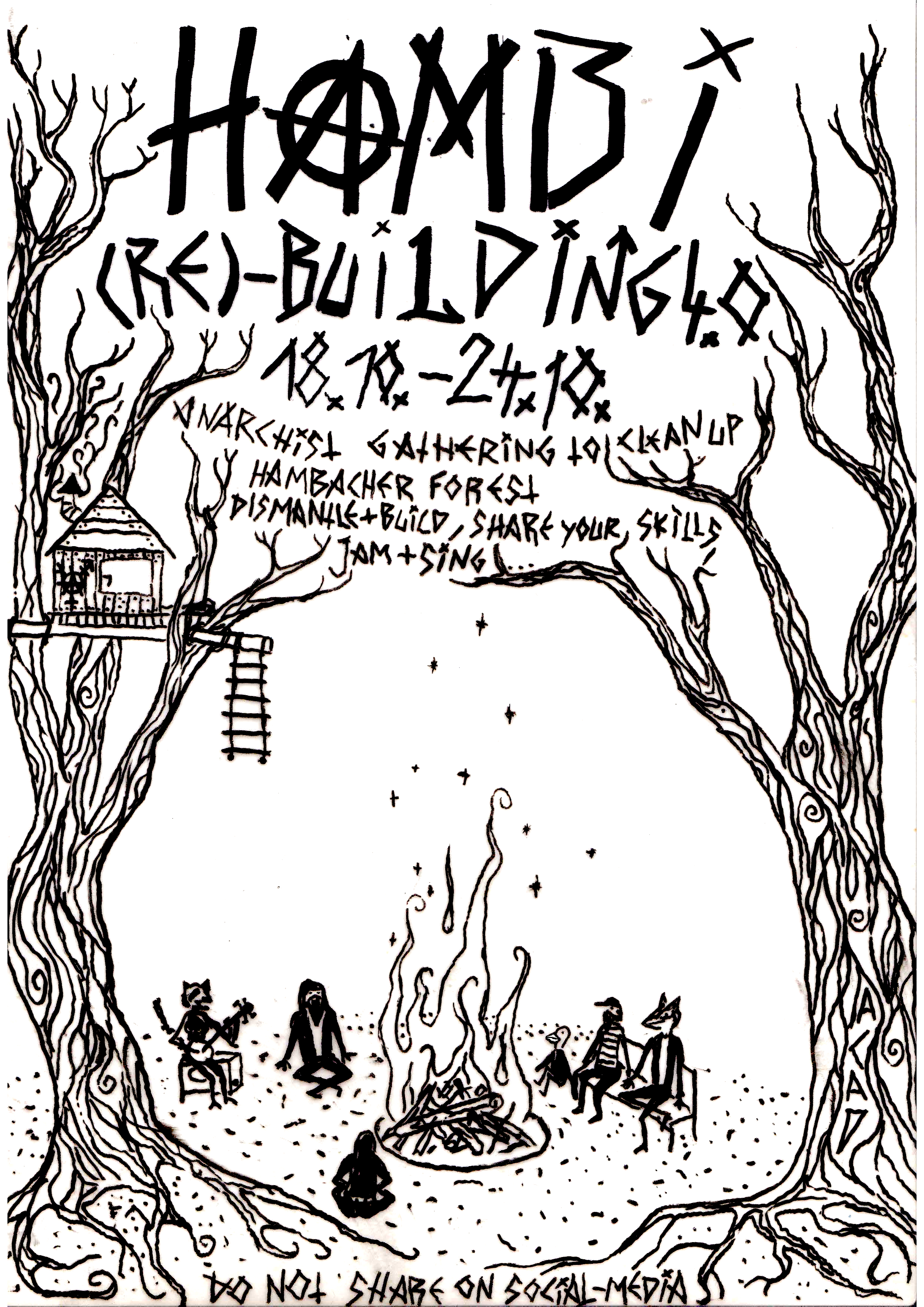
Die Geburtstagsfeier fand statt inmitten der Hambi (Re)Building Days. Das 10-tagige Event war ein Anlass der viele von uns zurück in den Wald brachte, lange waren wir hier nicht mehr so viele. Während der Tage wurden Strukturen abgebaut, andere renoviert und ein Container voll Müll entsorgt, der nicht im Wald verbleiben soll. Wir senden einen warmen Dank an alle die auf die eine oder andere Art an diesem großartigem Beitrag beteiligt waren. Vielleicht ist dies der Anfang einer neuen Zeit für diesen Ort.
In Zeiten geopolitischer Krisen und einer sich immer weiter zuspitzenden Energiekrise ist die deutsche Ökonomie unter erneutem Druck lokale fossile Energien bereitzustellen. Wir hören also die Regierung (wieder einmal) über das Verzögern des Kohleausstiegs. Die einzig sinnvolle Reaktion darauf ist es die Barrikaden hoch zu stapeln, unsere Baumhäuser dick genug zu dämmen, so dass sie noch viele Winter standhalten. Mit dem Hambi besetzen wir ein riesiges Reservoir Braunkohle und so lange der Kapitalismus andauert wird der Wald niemals sicher sein.
Trotz aller Höhen und Tiefen des Ortes ist der besetzte Wald nie einen Kompromiss mit dem Staat eingegangen. Der Wald bleibt eine der größten autonomen Zonen, die wir als antikapitalistische & radikal ökologischen Bewegung ausleben können. Tausende von uns haben über die Jahre für den Hambi gekämpft. Lasst uns immer fortfahren mit dieser einzigartigen Möglichkeit uns hier zu treffen, nah mit den Bäumen zu leben und den Kampf in den kommenden Jahren weiter gehen zu lassen.
Mit diesen Worten laden wir euch ein zu den Hambi (Re)Building Days #2, 18.-24. Juni 2026.
Lang lebe der Hambi!
Einige Waldwesen
____________________________
AN UPDATE FROM THE FOREST:
Recently the occupied Hambacher Forest celebrated its 14th birthday. The occasion was met with flaming barricades and a few rounds of a game which the people here call “chaos ball”.
The birthday took place in the middle of the Hambi (Re)Building Days, and there were more of us here during the 10-day event than in quite some time. Structures were deconstructed, others were renovated, and one container was filled with old trash. We extend a warm thank you to everyone who contributed to this great effort in one way or another. Maybe it will be the beginning of a new phase for the place.
During times of ever-spiraling energy crises and geopolitical conflicts, the German economy faces renewed pressures for inputs of local fossil fuels. We hear the government talking (yet again) about extending the coal-exit. The only sensible response is to stack our barricades high, and insulate our treehouses thick enough for many more winters to come. Sitting on top of huge reserves of brown coal, the Hambi will never be safe for as long as capitalism continues.
Amidst the ups and downs of this place, the occupied forest never compromised with the state. It remains the largest autonomous space which the broader anti-capitalist/radical ecological movement in the German territory has to play with. Thousands of us have fought over the years to defend and maintain the Hambi. Let’s continue to enjoy this precious opportunity to come together, live close to the trees, and keep up the fight for years to come.
In this spirit, we invite you to the Hambi (Re)Building Days #2, June 18-24, 2026.
Long live the Hambi!
Some forest critters.
Antwort auf 2 Blogposts Sommer 2025 [DE]
Jede Veröffentlichung aus dem Hambi drückt nur die Meinung einzelner Wesen, nicht die der gesamten Besetzung oder des gesamten Waldes aus.
Hier eine Rückmeldung zu ein paar seltsamen Positionen, die über den Blog verbreitet wurden. Wir beziehen uns auf diese beiden Posts:
„Irre“ (https://hambacherforst.org/blog/2025/06/25/irre/)
„Manheim soll weichen – für die Inseln der Reichen“ (https://hambacherforst.org/blog/2025/08/09/manheim-soll-weichen-fuer-die-insel-der-reichen/)
Die grundsätzliche Idee, die sich durch diese beiden Blogposts zieht, lässt sich wie folgt zusammenfassen: Es gibt „böse, böse Leute“, die aus egoistischer Gier unseren Planeten verpesten wollen. Dieser falsch vereinfachten Position möchten wir widersprechen. Den „Bösewichten“ wird weiterhin auch gleich noch eine psychische Krankheit unterstellt, was überhaupt nichts mit der Realität von psychischen Störungen zu tun hat und hier auch einfach ziemlich unpassend wirkt. Die gesamte Welt wird von einem ökonomischen System beherrscht, dass sich Kapitalismus nennt. Einzelne Personen können sich dafür oder dagegen entscheiden dabei mitzuspielen, aber ein dahingeschriebener Angriff auf irgendwelche „Systemlinge“ wird das System nicht ins Wanken bringen, es basiert nämlich auf ökonomischen Gesetzen, die Einzelne dazu bringen, dass sie z. B. die Umwelt verschmutzen. RWE hat den Auftrag von den Anteilseignern der AG so viel Gewinn wie möglich zu erwirtschaften, da spielt der Hambi oder die Umwelt keine Rolle.
Sind die RWE-Bosse schlechte Menschen? Vielleicht. Aber ihre Privat-Person spielt hier keine Rolle, sondern ihre Rolle als Manager, die von den Anteilseignern eingesetzt werden. Wenn sie also nicht dem kurzfristigen Gewinninteresse der Anteilseigner folgen, werden sie ersetzt. Das ist halt die Logik, die hinter diesem System steht. Da spielt die Moral einzelner Individuen keine Rolle, sonst können wir uns gleich erhängen, weil wir alle mal Schokolade gekauft haben, die von versklavten Kindern angebaut wurde. Die Kapitaleigner und ihre Knechte haben sicherlich mehr Schuld auf sich geladen als der Durchschnittskonsument, aber wir sind hier nicht Teil der katholischen Kirche – Schuldig sind wir alle, wir könnten sicherlich irgendwo noch moralischer handeln, als wir es eh schon tun.
Diese ewige Suche nach Sündenböcken ist kontraproduktiv und führt nur zu Sektierertum und Dogmatismus. Wer sich der Freiheit Aller entgegenstellt, muss mit Gewalt rechnen. Dieser Mensch ist ein Knecht der jetzigen Ordnung, aber deswegen nicht gleich ein „Sünder“. Er ist ein Hindernis auf dem Weg zur Befreiung und muss aus dem Weg geschafft werden (d. h. diese Person zur Aufgabe ihrer Rolle zu bringen oder sich nicht von ihr behindern lassen) wenn es auf die freundliche Art nicht klappt, dann zur Not auch mit Gewalt . Wir haben nichts gegen ihn persönlich, sondern gegen die Rolle, die er gerade einnimmt. Legt er diese Rolle ab, so kann uns seine Schuld relativ egal sein – Hass und Rachedurst kann Menschen zerfressen und ist zumeist nicht gerade hilfreich. Es ist meist effektiver den Weg zu beschreiten, der uns alle zur Befreiung führt, als den eigenen Verletzungen hinterherzulaufen. Natürlich ist dieser Hass gegen den Unterdrücker sehr verständlich und ein toter Politiker mehr oder weniger ist auch nicht weiter schlimm, in Anbetracht all der Millionen Toten die durch ihre Entscheidungen geopfert wurden. Doch sollten wir nicht vergessen, dass der Hydra immer neue Köpfe nachwuchsen, wenn einer abgeschnitten wurde. Sie wurde besiegt, indem ihr Rückgrat gebrochen wurde. Die „Bestie“ Kapitalismus kann auch nur gebrochen werden, wenn der ganze Apparat, das System dahinter, ausgeschaltet wird – auf welche Art und Weise ist dann natürlich eine andere Frage, die wir hier nicht beantworten können.
Wir sind keine Ökopriester und suchen keine Sünder, um ihnen Spendengelder abzupressen. In diesem Sinne ist es wohl auch ein guter Apell an alle Menschen, denen die Umwelt am Herzen liegt, sich nicht auf das müßige „Blame-Game“ einzulassen, sondern an tatsächlichen Alternativen und Experimenten mitzuarbeiten. Dieser Wald ist eines dieser Experimente und steht allen Menschen offen, sich an diesem Experiment zu beteiligen. (Solange ihr euch nicht in den Weg der Befreiung stellt und diesen Wald für Forstwirtschaft, Wissenschaft oder Tourismus etc. ausbeuten wollt.)
Freiheit kann nur erreicht werden, wenn Alle die Freiheit haben, zu wachsen und nach eigenem Empfinden ihr Leben zu gestalten – ob Mensch, Tier oder die Natur als Ganzes!
- 1
- 2
- 3
- 4
- …
- 261
- Gehe zur nächsten Seite